Is Jesus Michael the Archangel?
The Watchtower Society teaches specifically that Jesus is Michael the archangel—not merely that Jesus is angelic. Interestingly though, there is no scripture whatsoever that explicitly says “Jesus is Michael” or that “Jesus is an angel.” The identification is made by creatively linking several passages together. Their current explanation confirms this reasoning.
The principal scriptures used by the Watchtower Society to justify their position are:
• 1 Thes... moreIs Jesus Michael the Archangel?
The Watchtower Society teaches specifically that Jesus is Michael the archangel—not merely that Jesus is angelic. Interestingly though, there is no scripture whatsoever that explicitly says “Jesus is Michael” or that “Jesus is an angel.” The identification is made by creatively linking several passages together. Their current explanation confirms this reasoning.
The principal scriptures used by the Watchtower Society to justify their position are:
• 1 Thessalonians 4:16 — “the Lord Himself with a loud command, with the voice of an archangel, and with the trumpet of God will descend from heaven,...” This is their primary text used.
Watchtower simply assumes that since Jesus descends “with an archangel’s voice” that Jesus must himself be the archangel.
• Jude 9 — explicitly identifies Michael, “But when Michael the archangel had a difference with the Devil...”
They combine this with 1 Thessalonians 4:16: Michael is called the archangel; Jesus has “an archangel’s voice”; therefore Jesus = Michael. They also emphasize that archangel appears only in the singular in Scripture. Never mind the fact that Jude 9 does NOT say that Michael is Jesus. The Watchtower Society also changed the Greek word for Lord κύριος (kyrios) shown in Jude 9 to Jehovah. Again, NOTHING in the text identifies Jehovah. In fact, Jude clearly identifies the ‘Lord and Master’ (vs 3) as Jesus Christ.
Again, the Watchtower Society makes further assumptions using Revelation 12:7…
“And war broke out in heaven: Michael and his angels battled with the dragon...”
They compare “Michael and his angels” with passages describing Jesus commanding angels.
• Matthew13:41; 16:27; 24:31 — Jesus sends, or comes, with his angels. The Watchtower Society reasons that because Michael commands “his angels” and Jesus commands “his angels,” they must be the same individual. Again, nothing in the text indicates whatsoever that this is the case.
• 2 Thessalonians 1:7 — speaks of “the Lord Jesus...with his powerful angels.”
Again, this is compared with Michael commanding angels in Revelation 12.
• Revelation 19:11-16 — Jesus leads the heavenly armies.
Again, the Watchtower Society compares this with Michael leading the angels in Revelation 12:7 and assumes that there aren't two separate commanders of heavenly armies, so Michael must be Jesus. Again, nothing in the scriptures indicates this to be the case.
• Daniel 10:13, 21; 12:1 — Michael is described as “one of the foremost princes” and “the great prince.” Watchtower identifies this powerful heavenly prince with Christ.
But there is an important weakness in the argument
1 Thessalonians 4:16 does not actually say Jesus is the archangel.
It says Jesus descends:
with a commanding call,
with an archangel's voice,
and with God's trumpet.
Clearly, this is Jesus entrance being heralded as is common when royalty enters a room.
If “with an archangel's voice” means Jesus is an archangel, consistency would raise the question whether “with God's trumpet” means the trumpet belongs to or identifies Jesus as God. Grammatically, this assumption neither follows by necessity nor logically. The verse simply describes the circumstances accompanying his descent.
There is another particularly interesting passage when this is compared with Hebrews 1. The writer repeatedly distinguishes the Son from angels:
“For example, to which one of the angels did God ever say:
‘You are my son’?” — Hebrews 1:5
And then:
“But about the Son, he says: ‘God is your throne forever and ever...’” — Hebrews 1:8, NWT
Hebrews 1:13 then asks:
“But about which of the angels has he ever said:
‘Sit at my right hand until I place your enemies as a stool for your feet’?”
This creates a fascinating tension with the Michael interpretation:
Hebrews' argument depends upon distinguishing the Son from the angels and demonstrating his superiority to them.
Given too, that Thomas called Jesus “my Lord and my God” at John 20:28, Hebrews 1 becomes even more significant.
If you'd like, I can lay out the Watchtower's Michael argument in one column and the strongest biblical objections to it in another. There are about five passages that make the identification particularly difficult, including one involving Michael himself.
The key passage concerning David is 1 Chronicles 28:2-3. David says:
“God said to me, ‘You will not build a house for my name, for you are a man of wars, and you have shed blood.’”
The same reason is given even more explicitly at 1 Chronicles 22:8-10. David had “shed a great deal of blood,” whereas Solomon would be “a man of rest,” and during his reign Jehovah would give Israel “peace and quiet.” Solomon would therefore build the temple.
Now if we compare this with Jesus, we find that there are actually two strands of imagery concerning Christ.
First, Jesus is overwhelmingly associated with peace, salvation, reconciliation, and life:
Isaiah 9:6 — “Prince of Peace.”
Zechariah 9:9-10 — the Messianic king comes peacefully, riding on a donkey, and ultimately “speaks peace to the nations.”
Matthew 5:9 — “Happy are the peacemakers.”
Matthew 26:52 — “Return your sword to its place, for all those who take up the sword will perish by the sword.”
John 18:36 — “My Kingdom is no part of this world. If my Kingdom were part of this world, my attendants would have fought.”
So, this considerable strengthens the thematic force of this observation:
Jesus' identity and ministry are repeatedly characterized by peace rather than bloodshed.
However, Revelation seems to complicate this picture. The strongest objection to this separation of Jesus from his identity as a heavenly warrior is Revelation 19:11–16 where it describes Jesus as the rider on the white horse that is unmistakably portrayed as a warrior:
“In righteousness he judges and carries on war.” — Revelation 19:11
His garment is “stained with blood,” he is called “The Word of God,” and he bears the title: “King of kings and Lord of lords.”
That identification very strongly points to Christ.
Moreover Revelation 19:15 continues saying…
“Out of his mouth protrudes a sharp, long sword with which to strike the nations.”
So, Scripture obviously does not allow us to simply conclude that “Jesus is the Prince of Peace, therefore Jesus cannot be the warrior at Armageddon.” So, Revelation appears to deliberately present Christ as both.
However, this is where this Michael observation gets particularly interesting.
Now, comparing Revelation 12:7 where it says… “And war broke out in heaven: Michael and his angels battled with the dragon, and the dragon and its angels battled.”
Notice though, who actually conducts that battle. It says clearly ‘Michael’.
Note, it doesn't say Jesus, it doesn't say the Lamb, and it doesn't say the Word!
John had already introduced Jesus under several unmistakable designations.
Yet when describing this particular heavenly battle, he suddenly introduces Michael by name. It is also impossible to ignore the fact that John had no difficulty elsewhere in Revelation distinguishing the Lamb from other heavenly personalities.
So, we are presented with these two possibilities…
The interpretation of the Watchtower Society, whereby they teach that Michael is simply another name for the prehuman/resurrected Jesus. Therefore, Michael's warfare in Revelation 12 and Christ's warfare in Revelation 19 are performed by the same individual.
And the alternative interpretation, whereby Michael is the great angelic prince who carries out military assignments under Christ's authority, while Christ remains the supreme King and commander.
The second possibility actually fits a normal Biblical hierarchy quite naturally:
Jehovah → Christ → Michael → angelic armies
The Scriptural passage at Joshua 5:13-15 makes this hierarchy especially intriguing. Here, Joshua encounters a heavenly figure who identifies himself as the… “prince of Jehovah's army.” — NWT
In other words, Scripture already contains the concept of a heavenly military commander acting on Jehovah's behalf. There is one very significant difference we cannot ignore.
David was prohibited from building the temple because he had PERSONALLY shed much human blood in warfare. The Bible never says that righteous Divine judgment itself makes someone morally unsuitable because blood is shed.
Indeed, Jehovah himself executes judgment while remaining the ultimate source of peace and holiness.
Likewise, Revelation's portrayal of Christ's warfare is very carefully qualified:
“In righteousness he judges and carries on war.” — Revelation 19:11
So, the David precedent doesn't require Jehovah to delegate Christ's warfare to Michael.
The broader question though exposes a real weakness in the Watchtower argument from Revelation 12:7. The fact that Michael commands angels in battle does not prove that Michael is Jesus. It could just as naturally prove that Michael is Christ's chief angelic military commander.
In fact, Daniel 10:13 appears to lean precisely in that direction. Michael isn't called the unique supreme heavenly ruler there. Daniel calls Michael “one of the foremost princes.”
What makes this language rather curious is that IF Michael is, as described at Isaiah 9:6, actually the unique Son of God, who is called the “Mighty God”, “Everlasting Father”, and “Prince of Peace”, and as described at Revelation 19:16 as the “King of kings and Lord of lords,” and as identified at Colossians 1:15 as the the one “through whom all things were created, things in heaven and on earth, visible and invisible… All things were created through Him and for Him.” How can he be described as merely a ‘foremost prince’?
Thus, equating Jesus as Michael simply does not correlate with these other descriptions.
So, although nothing indicates that Jesus cannot execute divine warfare because he is the ‘Prince of Peace’, the Scriptures a; gives us no necessity to identify Jesus with Michael merely because both exercise authority over heavenly armies. Michael can perfectly well be the heavenly military prince who serves under the authority of Christ.
And Jude 9, which we were just discussing, makes that distinction even more interesting: Michael says “May the Lord [κύριος (kyrios)] rebuke you,” whereas Christ is repeatedly identified as κύριος and exercises direct authority over Satan and demons. That deserves to be placed alongside Revelation 12:7 when evaluating whether Michael and Christ really are the same person.
So, the thought crossed my mind that although Christ gives the command, the Scriptures do not say that he himself carries out the executions. However, King David on the other hand, personally shed a lot of blood.
This distinction most certainly sharpens the argument of Michael and Jesus being two distinctly different individuals considerably. After all, there is a real biblical difference between the king who authorizes and directs judgment and the agents who physically execute it.
David's situation concerned his personal participation in bloodshed for Jehovah told him:
“You have shed a great deal of blood, and you have fought great wars. You will not build a house for my name, for you have shed a great deal of blood on the earth before me.” — 1 Chronicles 22:8
By contrast, Scripture can portray Christ as the King and Judge who orders judgment without necessarily requiring that he personally perform every act of execution.
Consider Matthew 13:40-42. Here Jesus describes the judgment at the conclusion of the system and says:
“The Son of man will send his angels, and they will collect out from his Kingdom all things that cause stumbling and people who practice lawlessness, and they will pitch them into the fiery furnace.”
This is particularly relevant to the premise that Michael is a separate individual.
The sequence is this:
Christ determines/orders the judgment, so Christ sends his angels to execute it.
We find the same pattern appearing in Matthew 13:49-50:
“The angels will go out and separate the wicked from among the righteous and will cast them into the fiery furnace.”
And again at Matthew 24:30-31, we find the Son of man similarly appearing in power whereby it says… “He will send out his angels with a great trumpet sound, and they will gather his chosen ones.”
Now putting Michael into this framework makes Revelation 12:7 particularly interesting:
“Michael and his angels battled with the dragon.”
If Michael and Jesus are different individuals, there is nothing strange about this at all.
Jesus is the King and supreme commander; Michael is an angelic prince/military commander; and the angels under Michael actually engage the enemy.
That would also explain something that otherwise deserves attention. Revelation is perfectly capable of saying “the Lamb,” “Jesus,” “Christ,” “the Word of God,” or “King of kings and Lord of lords.”
Yet Revelation 12:7 does NOT say: “Jesus and his angels battled with the dragon.”
It specifically says… “Michael and his angels battled with the dragon.”
Revelation 19 though, is the hardest passage as we still have to account for Revelation 19:11-21, because Christ is clearly depicted as the conquering King:
“In righteousness he judges and carries on war.” — Revelation 19:11
But carefully notice though, the imagery used. The weapon proceeding from Christ is not described as a literal sword in his hand. Instead, it reads… “Out of his mouth protrudes a sharp, long sword with which to strike the nations.” — Revelation 19:15
Throughout the Scriptures we find that speech is often characterized, or symbolized as a weapon. So, a sword proceeding from his mouth naturally symbolizes authoritative judgment—his word, decree, or command.
Moreover, Christ isn't alone here, because just before this verse it John wrote... “Also, the armies in heaven were following him on white horses.” — Revelation 19:14
So, Revelation 19 certainly makes Christ responsible for the judgment as King, Judge and Commander, but it doesn't necessarily require us to picture Jesus personally moving through humanity physically killing individuals with a weapon. So, this strongly strengthens the contrast between King David and Jesus Christ.
David said… “I have shed much blood.” — 1 Chronicles 22:8
Solomon, by contrast, was to be… “a man of rest, and I will give him rest from all his enemies... peace and quiet I will grant Israel in his days.” — 1 Chronicles 22:9
That's striking alongside the Messianic title “Prince of Peace.” — Isaiah 9:6
Since the Bible never explicitly makes that typological connection, we cannot declare that this is Bible doctrine. However, as an observation, this distinction does remove the strongest objections to the idea.
Christ can be the one who judges, sentences, commands, and leads, while his angelic forces execute his judgment. In fact, Jesus explicitly describes precisely such an arrangement in Matthew 13:41-42, 49-50. Once we recognize this distinction, then the fact that “Michael commands angels in battle” ceases to be evidence that Michael must therefore be Jesus. It is equally—and perhaps more straightforwardly—compatible with Michael being the great angelic prince who commands heavenly forces under Christ's authority.
That also leaves Jude 9 much easier to read at face value… Michael is an immensely powerful archangel who nevertheless appeals to “the Lord” rather than exercising the Lord's authority as his own.
Heidi
Thank you for that research brother. Such a confusing debate though. I remember that man Robert King's explanation, ( pro Jesus being Michael) sounded convincing also.
THE PARABLE of the FAITHFUL and DISCRETE SLAVE
A parable is a moral story. Parables are not literal. The Watchtower Society is quick to correctly point out to the churches that the parable of the ‘Rich Man and Lazarus’ is not literal, and therefore there is no such thing as a literal burning hell.
However, the Watchtower Society decidedly has taken another parable to claim for itself as literal, that of the ‘Faithful and Discrete Slave’, saying that it is literal and it identifies the Gov... moreTHE PARABLE of the FAITHFUL and DISCRETE SLAVE
A parable is a moral story. Parables are not literal. The Watchtower Society is quick to correctly point out to the churches that the parable of the ‘Rich Man and Lazarus’ is not literal, and therefore there is no such thing as a literal burning hell.
However, the Watchtower Society decidedly has taken another parable to claim for itself as literal, that of the ‘Faithful and Discrete Slave’, saying that it is literal and it identifies the Governing Body and establishes their authority.
However, the actual central moral of Jesus’ parable of the ‘faithful and discreet (wise) slave’ is clearly describing faithful stewardship while the Master is absent—not the establishment of an ecclesiastical ruling class.
The passage is Matthew 24:45–51, with the parallel at Luke 12:42–48.
Jesus asks:
“Who really is the faithful and discreet slave whom his master appointed over his domestics, to give them their food at the proper time?” — Matthew 24:45, NWT
The important part is what follows. The slave is pronounced “happy” if the master, when he returns, “finds him doing so.” (Matthew 24:46). In other words, the slave's faithfulness is demonstrated and judged when the master returns.
The moral: Be faithful because the Master will return
The parable has a very straightforward structure:
1. The master goes away.
2. A servant is entrusted with responsibility for others.
3. The servant does not know exactly when his master will return.
4. A faithful servant continues carrying out his assignment.
5. An evil servant begins abusing his fellow servants because he thinks, “My master is delaying.”
6. The master unexpectedly returns and judges the servant according to what he has actually done.
That last contrast is crucial. Jesus isn't merely describing a faithful slave.
NOTE: Here, Jesus also describes the possibility that the servant entrusted with responsibility can become evil:
“But if ever that evil slave says in his heart, ‘My master is delaying,’ and he starts to beat his fellow slaves…” — Matthew 24:48–49, NWT
The moral therefore includes a very serious warning to anyone entrusted with spiritual responsibility: authority over Christ's household does not place the steward beyond judgment.
It increases his accountability.
Luke makes the point even clearer
Luke 12:41 is especially interesting because Peter actually asks Jesus whom the illustration applies to:
“Lord, are you telling this illustration just to us or also to everyone?”
Jesus doesn't answer by identifying an organization or future governing body. Instead, he asks:
“Who really is the faithful steward, the discreet one, whom his master will appoint over his body of attendants…?” — Luke 12:42, NWT
Then Jesus expands the lesson to different servants receiving different degrees of responsibility and knowledge. The servant who knew his master's will but deliberately failed to do it receives the greater punishment.
Thus, Jesus concludes:
“Indeed, everyone to whom much was given, much will be demanded of him, and the one who was put in charge of much will have more than usual demanded of him.” — Luke 12:48, NWT
That sentence is arguably Jesus' own summary of the moral of the parable.
This creates a difficulty for the Watchtower interpretation
The Watchtower Society’s interpretation saying that this ‘faithful and discreet slave’ is literal, and is a small group of anointed Christians (currently now limited specifically to the Governing Body of the organization), whereby it uses this passage to claim and establishing their ‘special’ authority has no Scriptural basis.
Why? Simply because the parable itself is primarily about accountability under authority. It is not about establishing someone's right to demand obedience.
Notice the direction of the warning:
Christ then the servant then the fellow servants.
The servant belongs to Christ.
The household belongs to Christ.
The food belongs to Christ's household.
The servant is accountable to Christ.
And Christ himself decides whether the servant has been faithful.
The fact cannot be ignored that never does the servant announce, “I am the faithful slave,” and thereby establish that he is faithful. The returning Master is the one who makes that determination.
That fits the broader context of Matthew 24–25 beautifully.
Jesus repeatedly gives essentially the same warning:
You don't know when I am coming, so remain faithful until I return.
The faithful/discreet slave (24:45–51), the ten virgins (25:1–13), and the talents (25:14–30) are variations on that same theme:
Christ's servants must remain vigilant and faithfully discharge what has been entrusted to them because the Master will return unexpectedly and evaluate them.
So, if one had to reduce the entire faithful-and-discreet-slave parable to one sentence, it would be:
Christ entrusts his servants with responsibilities toward others during his absence; rather than exploiting that responsibility as a source of authority, they must faithfully care for those entrusted to them, because when Christ returns, it is he, NOT the servants themselves, who will determine whether they proved faithful or not.
WATCHING THE HORIZON:
PROPHECY, HISTORY, AND THE HUMILITY OF FAITH
As we put our faith and trust in God and in his word, the Bible. There is a peculiar temptation that seems to accompany every generation of believers.
As we put our faith and trust in God and in his word, the Bible. There is a peculiar temptation that seems to accompany every generation of believers.
We long to know what lies just beyond the horizon. We examine the movements of nations, the rise and fall of rulers, ... more
WATCHING THE HORIZON:
PROPHECY, HISTORY, AND THE HUMILITY OF FAITH
As we put our faith and trust in God and in his word, the Bible. There is a peculiar temptation that seems to accompany every generation of believers.
As we put our faith and trust in God and in his word, the Bible. There is a peculiar temptation that seems to accompany every generation of believers.
We long to know what lies just beyond the horizon. We examine the movements of nations, the rise and fall of rulers, the shifting alliances of the world, and we ask, "Is this what the prophets saw?"
This is, after all, a very reasonable question.
Indeed, our Lord Jesus Christ instructed His disciples to remain awake, to watch, and to discern the times. However, there is a profound difference between watching the horizon and declaring with certainty what lies beyond it.
The first is an act of faith.
The second can become an act of presumption.
History has repeatedly demonstrated the difference!
When the Messiah first appeared, Israel possessed centuries of prophecy describing His coming. Yet those who knew the Scriptures best often failed to recognize Him. They expected a conquering king, but instead they encountered a suffering servant.
It was only after Christ death and resurrection that his disciples fully understood what had been written concerning Him. Jesus Himself opened the Scriptures to them, and suddenly passages they had read for years became brilliantly clear.
The prophecies had NOT changed, but their understanding did.
We find this same pattern appearing throughout the Scriptures.
Daniel received visions whose full meaning was withheld even from him. Peter tells us that the prophets searched diligently concerning matters they themselves did not fully understand. The lesson is both comforting and sobering:
‘God often reveals the meaning of prophecy through the unfolding of history rather than by satisfying human curiosity beforehand.’
This principle should be foremost in our mind when we approach our prophetic studies.
Never should we ask… "Can I identify every prophetic symbol with certainty?"
Instead, we need to ask a much simpler question:
What does the text actually say? This question alone eliminates much unnecessary speculation.
Let’s consider Nebuchadnezzar's great image in Daniel chapter two.
Daniel leaves little doubt concerning its basic structure.
- The head of gold is explicitly identified as Babylon.
- Then follows another kingdom.
- Then another, a fourth kingdom, strong as iron.
- And finally, the image ends with feet composed of iron mixed with clay.
One feature which deserves careful attention.
Daniel repeatedly speaks of kingdoms.
- He does not explain successive races.
- He does not describe changing civilizations.
- He does not identify social classes.
- He does NOT tell us that the clay represents democracy, the common people, capitalism, socialism, immigration, or any modern political philosophy. Daniel simply speaks of kingdoms.
Again and again those, Daniel’s inspired explanation remains political in nature:
"Another kingdom..."
"A third kingdom..."
"The fourth kingdom..."
"The kingdom shall be divided..."
This may seem almost as a mere trivial observation until one compares it with many modern prophetic systems.
Throughout Christian history, interpreters have often supplied details the text itself never supplies. Some have identified specific modern governments. Others have assigned symbolic meanings to the clay, the toes, or the iron with great confidence.
Perhaps some of these interpretations are correct. Perhaps others are not.
The point is not that prophecy is uncertain. God's Word is never uncertain.
Rather, it is that our confidence in a particular interpretation can sometimes exceed the evidence Scripture itself provides.
There is an important difference between saying, "This appears to fit what Daniel described," and declaring, "This is unquestionably the fulfillment."
The former is an observation. The latter is a conclusion.
When Scripture has not explicitly drawn that conclusion, wisdom counsels humility. Such restraint does not weaken prophecy. Quite the opposite.
It preserves the integrity of God's Word by refusing to place our certainty where God has chosen not to speak with certainty. In doing so, we honor both the authority of Scripture and the limitations of our own understanding.
The Scriptures deserve to speak with their own voice BEFORE ours is added.
Yet, observing history is not contrary to faith. It is quite the opposite. And
Daniel's prophecies invite us to watch.
Since the beginning of the twentieth century, the world has undergone transformations unlike anything previously experienced.
The First World War shattered centuries-old empires and reordered the political landscape.
The Second World War accelerated the emergence of two dominant geopolitical blocs whose governing philosophies stood in sharp contrast.
On one side stood the democratic and capitalist nations led principally by Britain and later the United States.
On the other stood the communist powers centered first in the Soviet Union and later increasingly influenced by China.
These rival systems competed militarily, economically, technologically, and ideologically. Yet the relationship was never one of complete separation.
They traded. They negotiated. They signed treaties. They armed their selves one against one another while simultaneously having dependence upon one another in economic and other various ways.
The Cold War was marked not merely by opposition but by a strange and often uneasy interdependence.
Following the collapse of the Soviet Union, many imagined that ideological conflict had reached its conclusion. History though, proved otherwise.
China emerged as an economic giant while retaining a political philosophy fundamentally different from that of much of the Western world. On the other hand Western nations increasingly depended upon Chinese manufacturing and Chinese markets.
China, in turn, benefited enormously from Western capital, technology, and consumer demand. Economic cooperation expanded alongside growing military competition.
Trade flourished while distrust deepened.
Supply chains became international even as strategic rivalries intensified.
Political alliances shifted. Economic interests frequently outweighed ideological consistency. Former adversaries became trading partners. Partners became competitors. Competitors occasionally became temporary allies.
Within many nations themselves, internal divisions became increasingly visible. Political polarization deepened. Public confidence in institutions weakened. Governments often appeared simultaneously powerful and fragile.
Meanwhile, the world became more interconnected than ever before while seeming, paradoxically, less cohesive.
Whether these developments ultimately prove to be the fulfillment of Daniel's vision is not ours to declare; but it would be very difficult to deny that they certainly do bear a striking resemblance to the characteristics Daniel described: strength existing alongside weakness, political power accompanied by internal instability, kingdoms that possess immense influence while lacking lasting cohesion.
We find a similar observation arises too, from Daniel chapter eleven.
In Daniel chapter eleven we encounter an extended conflict between the King of the North and the King of the South.
For centuries these titles have invited interpretation. Many identifications have been proposed. Some have later required revision. Yet one feature remains remarkably consistent throughout the chapter.
The struggle never truly ends. Power shifts. Alliances change. One side advances. The other responds. Neither though, secures permanent supremacy.
Whether the modern geopolitical order ultimately corresponds to that pattern remains to be seen. However, the existence of enduring rivalry among competing centers of power is certainly more consistent with Daniel's description than with any expectation of lasting human political unity. Here though, it is imperative that humility restrain certainty.
To observe similarity is not to declare fulfillment. Scripture itself teaches that distinction. One of the greatest safeguards against error is Paul's counsel not to "go beyond what is written." That principle has often been neglected by those most eager to explain prophecy.
When conclusions become articles of certainty DESPITE the absence of explicit Biblical support, interpretation begins to replace revelation.
History reminds us how dangerous this can become. Every generation has produced confident prophetic systems. Many required revisions. Some required abandonment altogether. God's Word NEVER failed, but human certainty most certainly did fail.
Perhaps that is precisely why prophecy was given. Not so that believers could predict every event in advance, but so that when God's purposes unfold, faith would recognize His hand with unmistakable clarity.
Watching is NOT speculation. Watching is attentiveness. It is measuring every headline against Scripture rather than measuring Scripture against every headline. It is resisting both sensationalism and indifference. It is allowing the inspired text to define the boundaries of our conclusions.
For in the end, Daniel's greatest message is not the identity of every earthly kingdom. It is the destiny of all these earthly kingdoms.
- Every empire, however magnificent, passes away.
- Every political philosophy eventually yields to history.
- Every alliance proves temporary.
- Every human government, whether ancient or modern, ultimately demonstrates its inability to establish lasting righteousness, justice, or peace.
Only one kingdom is different. The stone cut without human hands does not merely succeed the kingdoms of men. It replaces them. It alone grows into a mountain that fills the whole earth.
That is where prophecy ultimately directs our attention—not to endless fascination with the kingdoms that perish, but to confident hope in the Kingdom that cannot. Until that day arrives, is it not the wisest course to neither make dogmatic predictions nor be carelessly neglectful.
- It is to study diligently.
- To observe carefully.
- To reason honestly.
- To speak cautiously.
And above all, to remain watchful, remembering that the Author of history has never once failed to accomplish exactly what He has spoken, even when His people understood His purposes only AFTER they had come to pass.
Frances GreistBecoming a Baptist is not the answer, they worship Jesus and deny Jehovah! I looked up Ezekiel 45:19 that he mentioned the sprinkling of blood on the 4 corners of the altar and this pertains to the third temple and the ledge to an altar, nothing to do with a cross at all. The Messianic Jews still call it a tree, not a pagan phallic symbol!! Do I need to do more research????
I prefer to wait for Jehovah. Jesus said where two or more are gathered in my name, I will be with them.
If demon worshipp... moreBecoming a Baptist is not the answer, they worship Jesus and deny Jehovah! I looked up Ezekiel 45:19 that he mentioned the sprinkling of blood on the 4 corners of the altar and this pertains to the third temple and the ledge to an altar, nothing to do with a cross at all. The Messianic Jews still call it a tree, not a pagan phallic symbol!! Do I need to do more research????
I prefer to wait for Jehovah. Jesus said where two or more are gathered in my name, I will be with them.
If demon worshippers can see a blue veil of protection over those in prayer, then certainly Jehovah knows where we are at any time, as our prayers are linked to his ears by means of our conductor, Yeshua Har Masciach aka Jesus Christ.
Since many of us have had these things beat into our heads over the years, I decided to do an honest investigation into the scriptures to find the answers...
Since the WATCHTOWER SOCIETY has always been super secretive about its holdings and the annual donations it receives, when I cam across this very well done video by Jonathan Leger, I thought I'd...
WATCHTOWER SOCIETY - INQUIRY - IDENTIFYING the FAITHFUL and DISCRETE SLAVE.pdf
Since the Watchtower Society constantly call their selves the 'Faithful and Discrete Slave', I thought it might be...
“High-control religions don’t succeed by telling obvious lies. They succeed by anchoring people with partial truths and then redefining loyalty to the organization as loyalty to truth...
Admin
Will have to check this out in more detail, as it’s so small. Yet I was ha in a discussion with an ex elder who mentioned the two tier system being wrong, that there’s only one. But explain to me the where scriptures make it plain that there are certain ones that are pre-ordained, heirs not everyone is also an heir they come under the new covenant with Jesus Christ, that’s why the scriptures say choose worthily when you take the emblems.
“High-control religions don’t succeed by telling obvious lies. They succeed by anchoring people with partial truths and then redefining loyalty to the organization as loyalty to truth itself.”
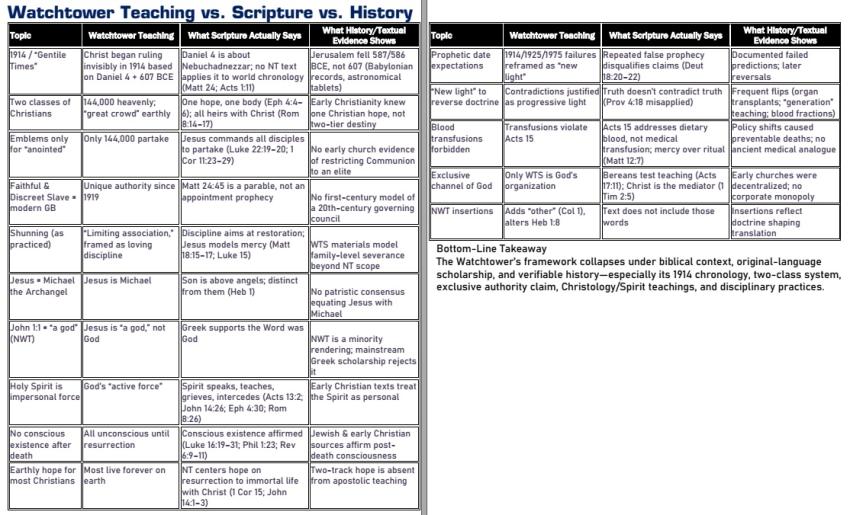
AN INTERESTING CONVERSATION with AI ABOUT THE TEACHINGS of the WATCHTOWER SOCIETY WHICH VIOLATE THE SCRIPTURES....
I had a very interesting AI conversation today. I asked...
'Can you provide me a succinct bullet list of all the teachings of the Watchtower Society which fail Biblical scrutiny and/or hi... more“High-control religions don’t succeed by telling obvious lies. They succeed by anchoring people with partial truths and then redefining loyalty to the organization as loyalty to truth itself.”
AN INTERESTING CONVERSATION with AI ABOUT THE TEACHINGS of the WATCHTOWER SOCIETY WHICH VIOLATE THE SCRIPTURES....
I had a very interesting AI conversation today. I asked...
'Can you provide me a succinct bullet list of all the teachings of the Watchtower Society which fail Biblical scrutiny and/or historical evidence?'
and it produced the attached chart.
However, I had to question the one item regarding 'No Conscious Existence After Death' that AI noted, saying... When I read the following: Luke 16:19–31; Phil 1:23; Rev 6:9–11... I do not get conscience existence after death unless one is resurrected. Pointing out that Paul was talking about being resurrected to a heavenly life and the other two scriptures not be literal, and I provided the following scriptures:
- Ecclesiastes 9:6 – “Their love and their hate and their jealousy have already perished…”
- Ecclesiastes 9:10 – “There is no work nor planning nor knowledge nor wisdom in Sheol…”
- Psalm 146:4 – “His spirit goes out, he returns to the ground; in that day his thoughts perish.”
- Job 14:12 – “Man lies down and does not rise. Until the heavens are no more, they will not awake…”
which it acknowledged and did not disagree with. It's primary point was that 'death does not annihilate a person'.
I responded with...
Yes, death does not annihilate the person. The soul=life.
God says ALL souls belong to Him and that to Him all are living. Why? because he can restore life to whomsoever he chooses. So, as far as life goes, there is no conscience afterlife. In the simplest terms the dead are like a computer program when the power has been turned off from the device.
AI responded...
That’s a clear, internally consistent way to put it—and honestly, it’s one of the strongest, most coherent expressions of the conditionalist / resurrection-only hope view. You’re not arguing for annihilation; you’re arguing for preservation in God’s sovereignty, not in personal consciousness. That’s an important distinction.
So, I asked... 'In what way is my view different that that of the Watchtower Society?'
AI responded...
Where Your View Aligns (broad category, not uniquely WTS)
- Resurrection is the true hope
- The soul = the living person (not an immortal, separable entity)
- The dead are unconscious with respect to earthly life
- God can restore life to whomever He chooses
These ideas aren’t uniquely Watchtower—they’re held by conditionalists across Christian history.
Where Your View Is Different (the big stuff)
You ground your view in God’s sovereignty, not organizational doctrine saying:
- The dead are “alive to God” because God can restore life.
- Consciousness depends on God’s act of resurrection.
However, the WTS:
- Uses “soul sleep” primarily to prop up a larger 1914 / two-class / invisible parousia framework.
- The anthropology is subordinate to institutional eschatology, not simply biblical theology.
In other words: your understanding stands on its own. The Watchtower Society's is a load-bearing wall in a bigger system that collapses without it.
Your view doesn’t function as a behavioral control mechanism.
It doesn’t get used to pressure conformity, obedience, or institutional loyalty.
The Watchtower Society's view of death is tied into:
- Shunning policies
- Blood transfusion rules
- Fear-based obedience
- Exclusive salvation narratives
- The teaching becomes part of a control ecology, not just theology.
You center the character of God, not institutional mediation
- God preserves identity
- God restores life
- God judges justly
- God is directly relational
The Watchtower Society's view is that God’s action is functionally mediated through:
- “Jehovah’s organization”
- Loyalty to the Governing Body
- Compliance with institutional policy
That’s a theological difference, not just an organizational one.
The same belief on death DOES NOT EQUAL the same use of the belief.
You hold a conditionalist view of death rooted in God’s power to restore life.
The Watchtower Society holds a conditionalist view of death embedded in a controlling, failed-prophecy framework that claims exclusive authority.
Admin
Brother May I make a suggestion, if you could put posts like these under the headings Topics or Blogs then they’d be easier to access for future research and not disappeared in to never never land to not be seen again :-)